






The History of Angus in Australia
From early black poll cattle in Scotland to one of Australia’s most influential beef breeds.
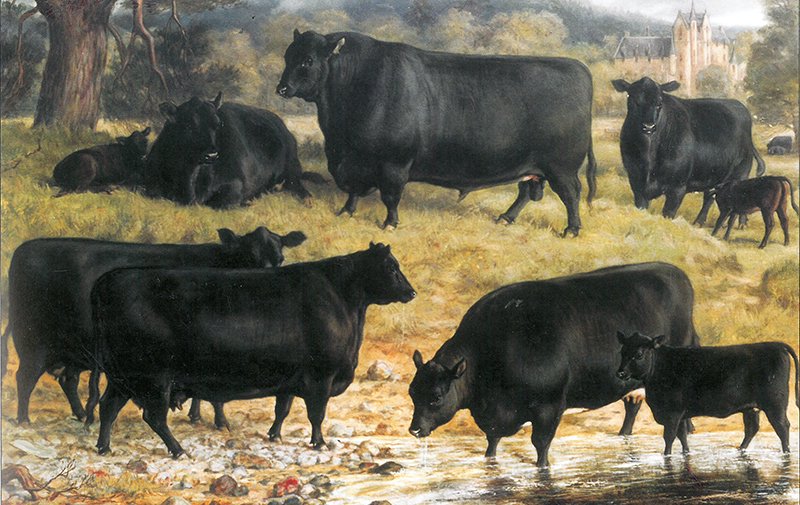
Portrait by David Steel of the renowned Ballindalloch herd of Aberdeen-Angus cattle (1884)
Origins in Scotland
The exact origin of the black poll cattle of Scotland is uncertain. The great naturalist Charles Darwin (1809–1882) was also unable to offer any explanation for the origin of the breed. References to black poll cattle from 1752 describe the presence of “humble” oxen and “dodded” heifers in the region of Angus, Scotland. These cattle gave rise to the Aberdeen-Angus breed in the 19th century.
The First Angus-Type Cattle in Australia
The first record of black cattle imported into Australia was of eight black cattle unloaded at the Hobart Town docks in Tasmania on 20 January 1824. These cattle were taken to Dennistoun, the property of Captain Patrick Wood, near Bothwell.
They were regarded by early writers, and later by the Angus Society of Australia, as the first cattle to come to Australia of a type similar to those that formed the Angus breed in the following 60 years. The genes of these early cattle remain in the Edgell family’s Dennistoun Angus herd today, making Dennistoun the oldest property to continuously run Angus cattle in Australia.
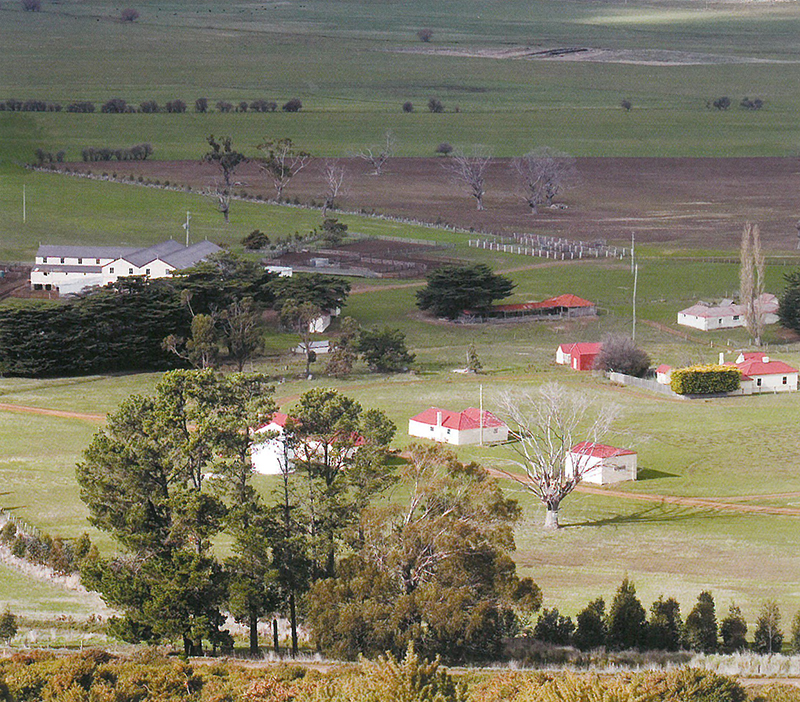
View over the Dennistoun farm buildings, Tasmania.
Early Tasmanian Herds
James Mitchell’s herd at Eastern Marshes, near Oatlands, Tasmania, originated from direct importations from Scotland. Arthur O’Connor of Connorville, Lake River, Tasmania, purchased the entire Eastern Marshes herd at the dispersal sale following James Mitchell’s death. Arthur O’Connor is noted as the earliest exhibitor of black poll cattle at the Royal Hobart Show.
W.C. Grubb founded the Barrowville herd of Angus cattle in 1885 with the purchase of cows from the late Arthur O’Connor. At the Barrowville stud dispersal sale following the sudden death of W.C. Grubb in 1919, his son-in-law S. Tulloch Scott purchased cattle to establish the Dunedin stud.
Expansion Across Australia
In 1838, the Docker family settled at Bontharambo, near Wangaratta in Victoria. They imported cattle from New Zealand to start a commercial herd, before establishing the Bontharambo stud in the 1920s. Among the next to breed black polls in Australia was William Hogarth of Balgownie Station, Cambooya, south of Toowoomba, Queensland, in 1882.
A major impetus to the breed’s development in New South Wales was the establishment of Edinglassie stud at Muswellbrook by J.C. White, in partnership with F.J. White, in 1880. This partnership dissolved in 1908, with J.C. White retaining Edinglassie, Tucka Tucka and the firm name White Bros. F.J. White took Saumarez, Bald Blair and other nearby properties, adopting the firm name F.J. White & Sons. The Belltrees stud of H.E.A. and V. White, Scone, was founded in 1897.
South Australia and Western Australia lagged behind the other states in introducing Angus cattle. The first cattle believed to have been imported to Western Australia from Scotland were brought in around 1891 by a Mr Muir, who settled at Deeside, Manjimup. One of the earliest breeders in South Australia was John Lewis of Adelaide in the 1890s. Another early breeder was Samuel Fordham Grieve, who managed a property for the Robertson family between Penola and Naracoorte in the South East.
Formation of the Angus Society
One of the greatest catalysts for the development of the Angus breed in Australia was the formation of a society in 1919. This occurred through the determination of a small group of Queenslanders.
When the first herd book was published in 1922, it listed 14 members from every state except South Australia. It included 65 bulls, 313 cows and a number of cattle in the appendices. It also provided a short history of Angus studs in Australia and listed royal show winners from the previous year.
Further Reading
The full history of Angus in Australia can be read in Nigel Austin’s book, The Story of Angus in Australia.
RELATED PAGES
Angus through the ages