Top Marks at SA Cattle School
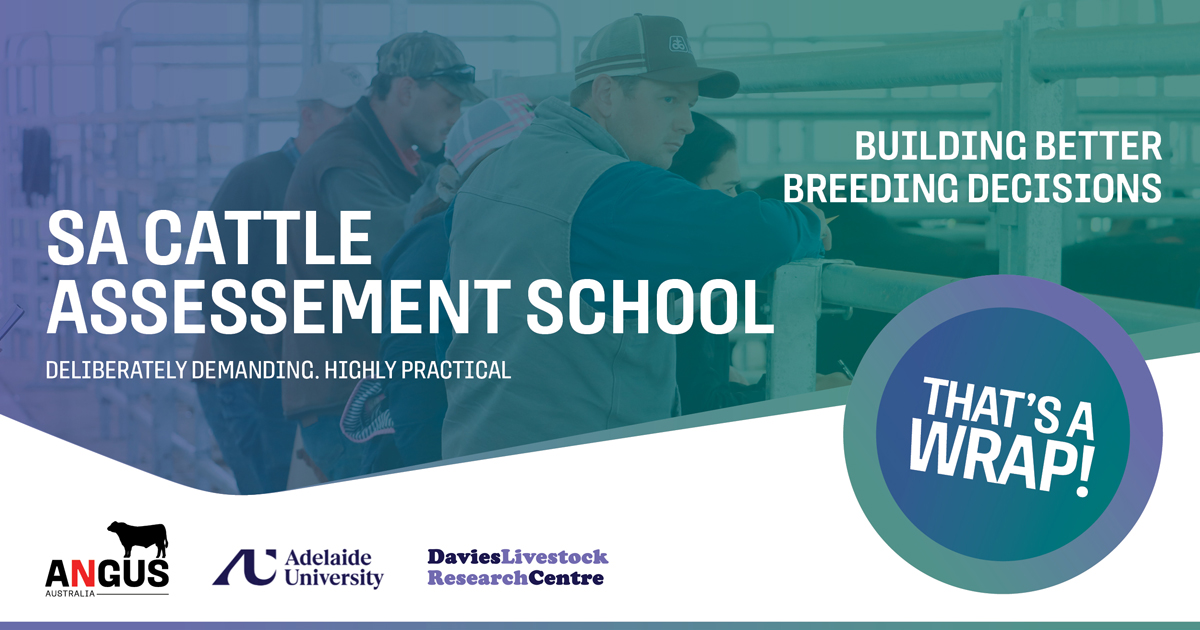





On 2nd and 3rd of October, thirty keen participants from across Australia converged on the University of Adelaide’s Roseworthy Campus for the SA Cattle Assessment School, signing on for two full-on days dedicated to sharpening commercial cattle assessment skills and building better breeding decisions. From early starts to late finishes, the cohort worked through a rigorous program that brought classroom theory to life in the yards, focusing on assessing classes for market suitability and replacements, and translating genetics into clear, practical breeding objectives.
Cattle were sourced from a range of operations to provide genuine variation and meaningful comparison. These included:
Across fourteen classes, participants analysed feeder steers, domestic and export prime cattle, replacement heifers and breeding bulls. Participants learned to evaluate the traits that matter: yield and muscle, fat cover and distribution, structure, temperament, and overall market suitability. Estimated Breeding Values (EBVs) were threaded through the bull selection exercises on day 2, anchoring making informed decision making using data rather than guesswork.
The format was deliberately demanding. For each class, students placed the cattle against a defined scenario or breeding objective over a few minutes, then turned their backs to the mob and fielded five observation questions—testing recall, attention to detail, and the strength of their reasoning.
“I came to learn where our clients want to sell their cattle and what we need to breed,” said Harry Nicholls, Bull Oak Well Angus, Pinnaroo, SA. “That was really good information we learnt this week. I’d recommend it to anyone, commercial or stud, who wants to broaden their knowledge.”
Harry’s brother, Cooper, added “Being from a stud, it was valuable to reflect on where our bulls are heading to reach the market. Great event. I’d definitely recommend it if you’re interested in cattle.”
This was also the first time the new Roseworthy yards have been used in this way; an investment by the Davies Livestock Research Centre and the University that paid off in spades for the success of the program.
“These facilities are world-class, and being among the first to use them was a real honour,” said facilitator Jake Phillips of Angus Australia. “As a former student, Roseworthy holds a special place in my heart and being able to help showcase the facilities and opportunities felt like a full-circle moment.”
The sentiment was echoed by participants eyeing commercial careers.
“I wanted to better my commercial knowledge as I head into our livestock agency family business and time up north next year,” said Zanna Spence, Keith, SA. “I learnt a lot about structure and phenotype—I’d recommend this course to anyone who wants to truly understand the commercial side, not just the stud side.”
“I came to broaden my knowledge of the commercial industry and how we as stud breeders can better support it. It was a great chance to judge cattle and learn how to prioritise different faults and market specifications,” said Olivia Baker, Furner, SA.
By late on day two, the scorecards told their story. The top five individuals, those whose placings were closest to over-judges James Laurie (Moppy, NSW) and Bryce Whale (Glen William, NSW), were:
Beyond the technical content, the school fostered open, practical discussion that builds capability across the sector. A three-course dinner, kindly supported by the Barossa Improved Grazing Group, provided time to compare notes and cement new connections, proving that learning doesn’t stop when the gates close.
The program draws on the tried-and-tested fundamentals of the Tocal Beef Cattle Assessment School, now entering its 45th year, with James, Bryce and Jake bringing the best of that format to a southern venue and an earlier slot in the calendar to avoid harvest clashes. The SA Cattle Assessment Course achieved a miraculous 9.9/10 average from participants when asked if they valued their attendance in the program. The cohort also submitted a 9.2/10 average score when asked if they intended to make changes to their operation due to attending the course.
The cattle donors and supporters were central to the school’s impact. The variety across breeds, types and target markets gave students perspective and confidence in their placings, and the new facilities made it possible to move efficiently between classes while maintaining welfare and safety. It all added up to a high energy, highly practical two days that left participants better equipped to assess, select and breed cattle with purpose and relevance.
The program would not have been possible without the generous donations of time from Emma Phillips (course facilitator), Bryce Whale (over-judge) and James Laurie (over-judge) and staff of the University of Adelaide including Professor Wayne Pitchford and Darren Koopman and the farm staff.
To express interest in enrolling in a future SA Cattle Assessment School, or to explore hosting a course elsewhere, contact Jake Phillips at Angus Australia.