Announcing the 2025 Angus Foundation Research Grant Recipients
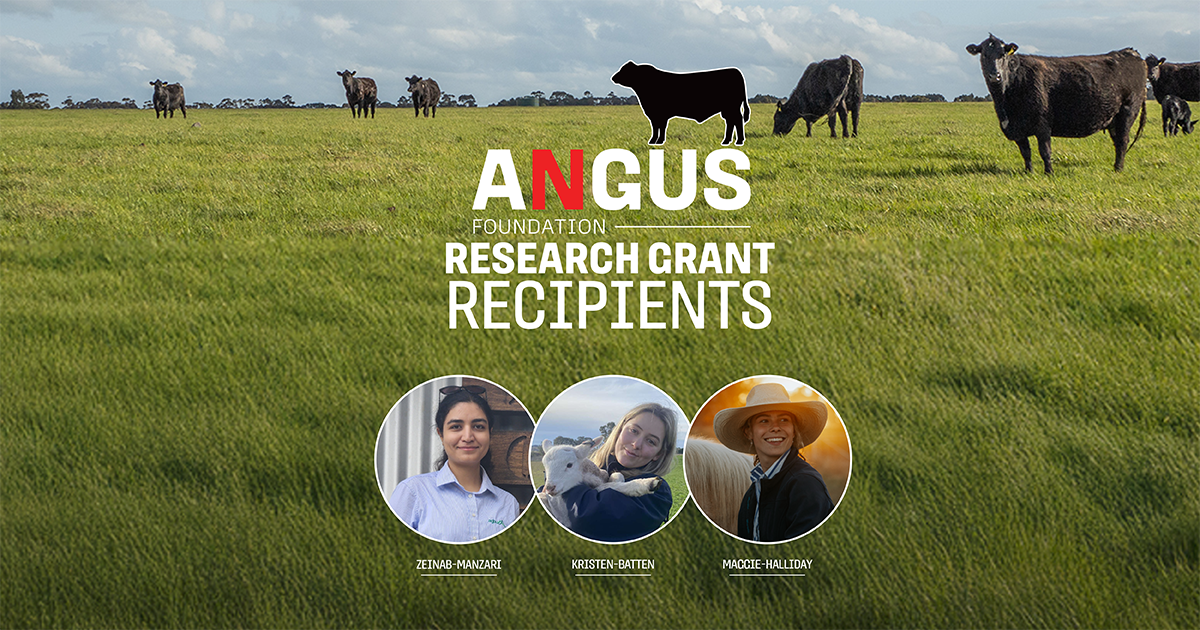





The Angus Foundation is excited to announce the recipients of the 2025 Angus Foundation Research Grant after an extensive selection process.
The Angus Foundation Research Grant supports undergraduate and postgraduate students in conducting research that benefits the Australian beef industry and aligns with Angus Australia’s goal of enhancing the value of Angus cattle and beef. The grant can be utilized for initiating new projects or for deriving additional insights from existing research that the individual or institution has already started.
After a successful shortlisting process and presentations to a selection committee, the Angus Foundation extends its congratulations to the following researchers, Zeinab Manzari, Maggie Halliday and Kristen Batten, who have been awarded the Research Grant to support their respective projects.
Angus Australia will oversee these projects over the course of the year and provide updates to members as the research findings become available.
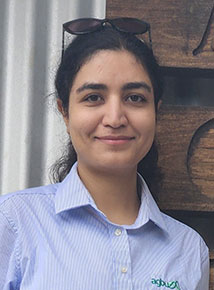 ZEINAB MANZARI – ANIMAL GENETICS AND BREEDING UNIT (AGBU)
Project Title: Genomic prediction using marker-specific weights for economic traits in the Angus breed
The beef industry faces an increasing demand for genetic improvement to enhance productivity and meet evolving market needs. The Angus breed is known for its calving ease, rapid weight gain, and carcass quality, making it highly valued in beef breeding programs. To ensure accurate breeding values, it is crucial to integrate genomic data into evaluation systems. Advances in genotyping techniques have driven the development of genomic-based methods, such as genome-wide association studies (GWAS) and genomic prediction (GP), offering enhanced opportunities for the precise selection of desirable traits. In the context of BREEDPLAN for Australian Angus, genetic markers are incorporated to refine relationships between animals, enhancing the accuracy of estimated breeding values (EBVs). The project explores how assigning appropriate weights to markers influences prediction accuracy, with the potential to optimise the use of genomic data to boost the productivity and performance of the Australian Angus breed.
Zeinab’s research supervisor, Dr. Mohammad Ferdosi described Zeinab as a “highly dedicated and hardworking PhD student with a strong commitment to learning and self-improvement.” He further noted her research contributions, stating, “Zeinab successfully completed several research projects, demonstrating exceptional attention to detail and the ability to thrive both independently and in collaborative environments. She approaches discussions with confidence and clarity, consistently showcasing excellent communication skills.”

MAGGIE HALLIDAY – UNIVERSITY OF NEW ENGLAND (UNE)
Project Title: Determining the relationship between meat quality and methane emissions in Angus beef cattle.
In the face of increasing pressure to prioritise agricultural sustainability, the beef cattle industry must adapt to minimize methane emissions while increasing production efficiency. Enteric fermentation in ruminants leads to methane (CH4) production, where cattle produce up to 80% of global livestock emissions (Gerber et al., 2013). The challenge lies in methane reduction strategies potentially impacting production, as methane output is positively correlated with dry matter intake (DMI) (r = 0.31) (Ryan et al., 2022). Thus, as ruminants consume more feed, they tend to produce more methane. Donoghue et al. (2016) found moderate to strong genetic correlations between a methane trait known as methane production (MPR), and animal weight traits, which was speculated to be due to the positive association between dry matter intake (DMI). The study also found MPR to be positively correlated with eye muscle area (EMA) (r = 0.4) and intramuscular fat (IMF) (r = 0.36). Similarly, Herd et al., (2014) estimated a phenotypic correlation between CH4 and EMA to be 0.29 ± 0.04. Ryan et al. (2022) emphasised these phenotypic findings produced a need for further investigation into potential genetic correlations to better understand these relationships.
Through identifying correlations between traits and methane output, the industry will be able to select Angus genetics that push for reducing methane while maintaining the integrity of the red meat production system. Building on this, the project aims to determine relationships that exist between carcass traits and methane emissions within Angus beef cattle, with the scope for also combining feed intake data. Key traits include eye muscle area, intramuscular fat, carcase weight and P8 fat. Increased understanding of these genetic and phenotypic correlations will determine whether there is scope for producers to select on both lower emissions and desirable carcass outcomes.
This study will have direct applications for Angus Australia’s members through providing an opportunity for further development on generating methane emission breeding values. Similarly, reducing methane emissions will also lend towards the red meat target goal of net zero by 2030.
Maggie’s research supervisor, Professor Sam Clark described Maggie as a “bright and talented student with a keen interest in Angus genetics.” Reflecting on her academic performance, he stated, “I had the pleasure of teaching Maggie in UNE’s third-year plant and animal breeding unit, where she excelled as one of the top students in the class. She combines excellent background knowledge about breeding programs with outstanding communication skills. Maggie has chosen a research topic of high interest to the industry, and her study is expected to deliver very interesting and applicable results. She will undoubtedly be an asset to the Australian beef cattle industry for many years to come.”
KRISTEN BATTEN – MURDOCH UNIVERSITY 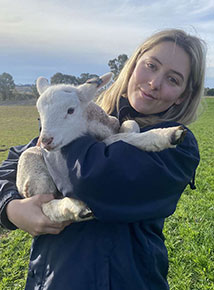
Project Title: Welfare impacts of rubber matting on cattle in abattoir lairage.
The study is investigating the impact of rubber matting on the welfare of cattle in Australian processing plants, and how these flooring systems compare to conventional types such as concrete and mesh. The project was created with the aim of investigating welfare conditions during the handling and housing of cattle in abattoir lairage. We will be taking pre and post mat installation observations greatly focused on the movement and behaviour of the cattle at the unloading ramp and during handling in laneways, in addition to observing the animals’ behaviours during overnight stays in holding pens. The research site currently has some matting installed; however, areas of the facility remain as unmatted, concrete or mesh flooring, allowing us to directly compare flooring types. We will also be taking post slaughter measures to observe the impact that stress may have on carcass quality. Rubber matting has previously been investigated for its use in housing systems for various livestock species overseas however, there has been no prior investigation into the impacts on cattle welfare in Australian abattoir systems. I am extremely excited for the results of this project and am honoured to have Angus Australia’s support in this endeavour towards improving Australian cattle welfare.
Kristen’s research supervisor, Dr Emma Dunston-Clarke, described Kristen as a “highly driven and dedicated student with a strong aspiration to pursue a career in livestock research.” Dr. Dunston-Clarke also added, Kristen has also demonstrated a passion for conducting worthwhile research that can inform industry on ways to improve practices and management for the benefit of animal and human welfare, as well as producer productivity.”