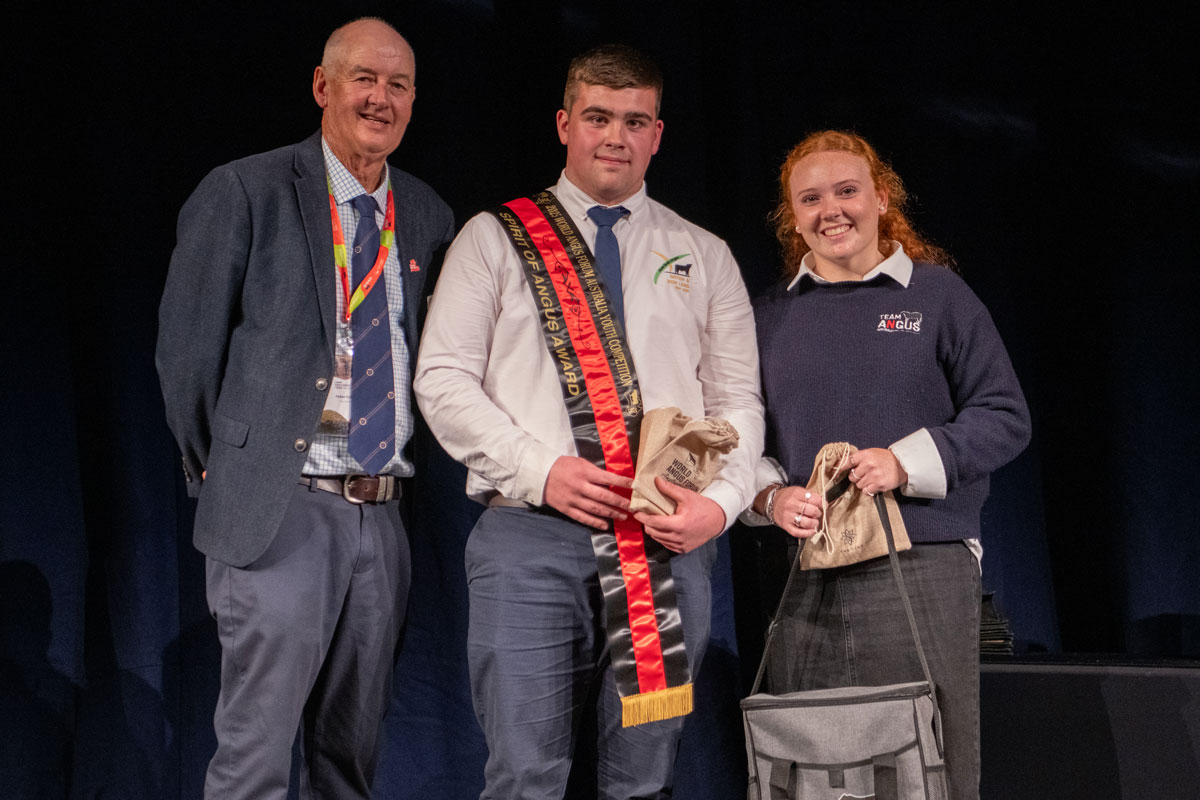
At the World Angus Youth Competition, James Morrison, Team Captain of the British and Irish Lions, was honoured with the Spirit of Angus Award.
Previously known as the Individual Champion, this award was reimagined after discussions with Mick Pratt, Chairman of Denmark Ag College in Western Australia.
Rather than recognising only the most academic or athletic competitor, the focus shifted to celebrating qualities that truly shape successful teams — a positive attitude, strong work ethic, and the ability to foster team culture.
The Spirit of Angus Award was created as a blend of Mick’s vision and the long-standing Merridale Heifer Award at the Angus Youth Roundup. It was designed to recognise not only individual achievement, but also the invaluable contribution of a genuine team player. Just as in the workplace where individual skill matters, collaboration is what drives success, and this award celebrates those who elevate the entire team.
Primary judge Peter Collins remarked, “James was a true all-rounder and a natural people person. He stood out for the deep respect and appreciation he showed toward his parents, grandparents, and everyone who supported his journey in agriculture.”
The award was strongly contested, with Matilda Salter named as reserve. Matilda was consistently encouraging and supportive of all the international youth competitors, helping them feel welcome and included throughout the trip.
Special thanks are extended to primary judge Peter Collins and his dedicated team of helpers for their time, expertise, and commitment in judging the Spirit of Angus Award at the Neogen World Angus Forum and its affiliated events. For the youth competitors, it was deeply meaningful to engage with experienced Angus breeders whose generosity in sharing knowledge and insights added immense value to the competition experience.
In addition to the prestige of the award, James earned a place in the 2026 GenAngus Future Leaders Program, supported by Achmea Farm Insurance, offering him the opportunity to further develop his leadership skills and build valuable connections across Australia.
To introduce James as our first GenAngus delegate for 2026 we thought we’d dig into his family operation, Drummeer Farm, in Northern Ireland and have a look at their farm system and challenges ahead. Through this, we are also learning more about what makes James tick, his career aspirations and what’s ahead.
Drummeer Farm Overview
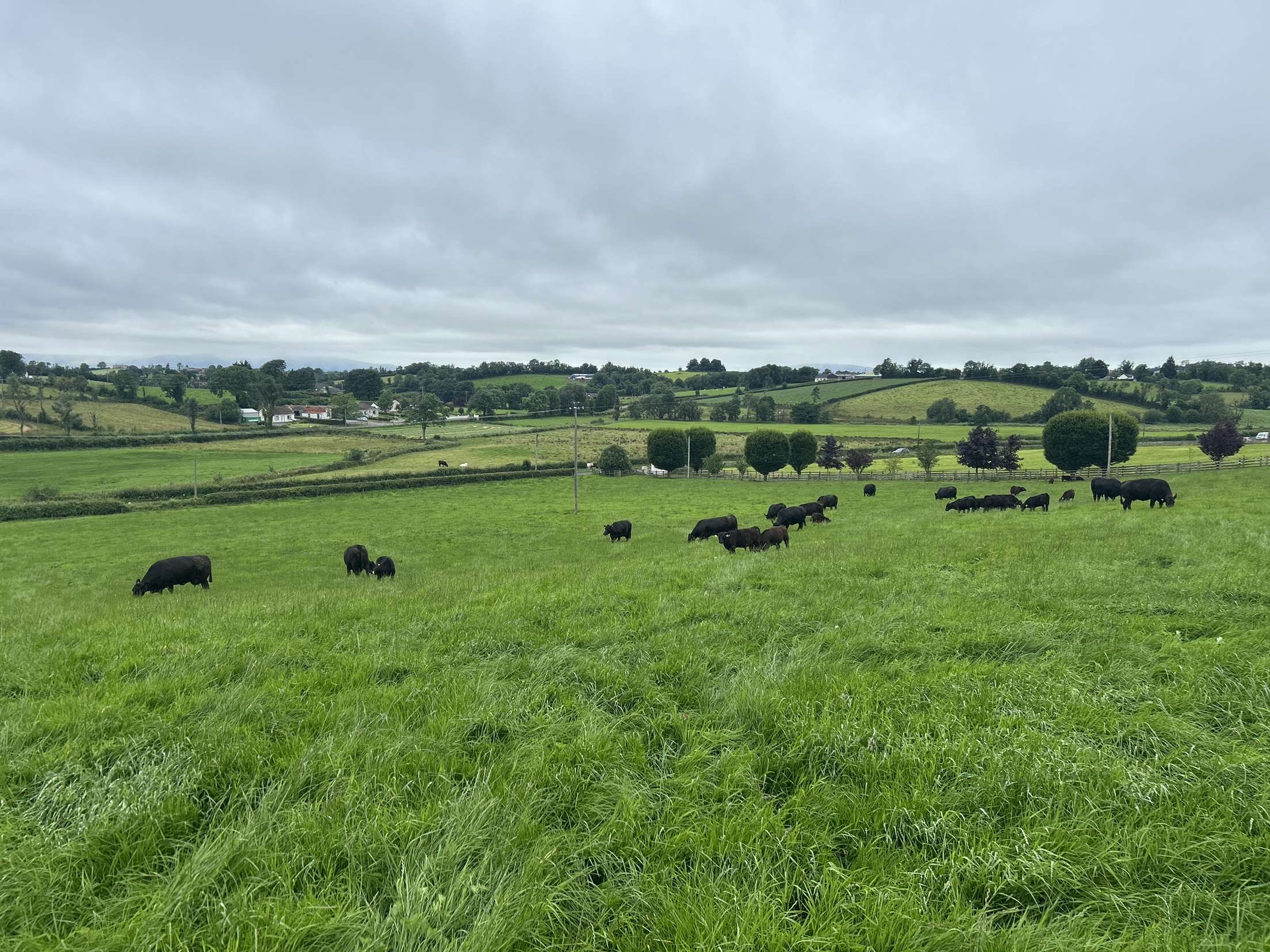
James comes from Drummeer Farm nestled in Maguiresbridge, County Fermanagh, in Northern Ireland. It is a 120-acre enterprise comprising of 60 acres of owned land and a further 60 acres rented, all devoted to grass production. With annual rainfall ranging between 44 and 54 inches, the farm’s acidic, clay-based soils are unsuited to cereal production but provide ideal conditions for high-output pasture systems.
The current stocking rate stands at 0.8375 livestock units per acre, slightly below the farm’s long-term average. The herd is a carefully balanced mix: 25 pedigree Aberdeen Angus breeding females, eight pedigree Charolais cows, and 30 crossbred cows incorporating Angus, Charolais, Limousin, and Hereford genetics. There is also a small flock of commercial ewes.
Breeding Philosophy and Management
Breeding management at Drummeer reflects the realities of Fermanagh’s wet climate, where summers are short and cows may only spend six weeks on grass. More than 70% of the herd is Aberdeen Angus, chosen for docility and their ability to thrive on heavy soils where continental breeds struggle. Angus cattle are naturally easy-fleshing and graze for an additional six weeks to three months compared with continental crosses, creating a natural cost advantage.
Breeding objectives are clear: every female, whether cow or ewe, must calve or lamb before 24 months. Temperament and daily liveweight gain are priorities, ensuring efficient growth while maintaining ease of management. Stock bull selection combines traditional assessment with modern science: phenotype is the primary filter, followed by pedigree and progeny evaluation, with genomic testing used to safeguard against genetic concerns.
Reproduction and Herd Strategy
The herd’s reproductive strategy maintains cash flow year-round, with only January and June calving-free – the former for lambing and the latter for silage. The majority of cows calve between March and May, with heifers following in July and August. Autumn calving carries through from September to December.
Heifers are joined at 12 to 15 months depending on weight and frame. Over the past three years, calving intervals have ranged from 314 to 397 days. While shorter intervals are desirable, off-farm employment and weather constraints present practical limitations.
Nutrition follows a grass-based system, with cows expected to maintain body condition on forage alone. A vitamin and mineral bolus is provided before calving, but supplementation is otherwise minimal.
Performance and Marketing
Drummeer Farm is performance focused. Calves typically weigh around 40kg at birth and gain 1.0–1.3kg per day with minimal concentrate input. Weanlings (weaners) leave the farm at 380–420kg, young bulls are finished at 16 months with carcase weights of 380–400kg, while finished cattle average 640kg live at 20 months. Lambs are sold at 46kg and above, from 10 to 12 weeks of age. Success is measured against repeat customers, average daily liveweight gain, and price per kilo achieved at sale.
The marketing strategy has evolved in recent years. While all crossbred cattle were previously finished on-farm, COVID-19 prompted a shift to selling forward steers through live markets, where demand and profitability proved stronger. Pedigree Angus bulls continue to be sold before 20 months, and all beef and lamb carry the Northern Ireland Farm Quality Assurance Scheme (NIFQAS) stamp, exceeding EU food safety and traceability standards.
A Personal Journey in Agriculture and Auctioneering
For James, cattle and auctioneering have been inseparable parts of life. From an early age he attended bull sales and livestock shows, sparking a passion for both breeding and the sale ring. At 15, he began working in the office of the local livestock market before gaining experience with Harrison & Hetherington (H&H), the UK’s largest livestock agency. That opportunity later led to full-time employment following the completion of his BSc in Sustainable Agriculture and Agri-Business.
Thrown “in at the deep end” at 18 when asked to sell cows at market, James embraced the challenge. He now takes pride in conducting the weekly weanling calf sale and cites auctioneering pedigree Dorset sheep at Carlisle as a career highlight.
The Morrison Family and Aberdeen Angus
The Morrison family’s history with Aberdeen Angus cattle stretches back generations. In the 1960s, James’s great-grandfather sourced Angus bulls across Ireland for local farmers under the Hillmount prefix. That name was revived in 2014 when the family’s pedigree herd was re-established at Drummeer. James’s grandfather, Edwin, purchased the farm decades earlier while balancing farming with full-time work, and in 2005, Alan and Elaine Morrison, James’s parents, founded the Drummeer Aberdeen Angus herd, coincidentally the very week James was born.
Today, Alan Morrison serves as President of the Aberdeen Angus Cattle Society, representing the breed nationally and internationally. Highlights of his tenure include visiting King Charles III’s Angus herd at the Castle of Mey, underscoring both the heritage and international reputation of the breed.
Challenges and Future Outlook in Northern Ireland
Northern Ireland agriculture faces major headwinds, from inheritance tax pressures to stricter nitrate regulations, as well as threats like Bovine Tuberculosis. Market and policy challenges underscore the need for leadership and innovation across the sector.
Jamess says his experience representing the UK and Ireland at the World Angus Youth Competition in 2025 was transformative. It opened doors to judging invitations, cattle preparation contracts, and global networking opportunities. He plans to attend the GenAngus Future Leaders Program in 2026 to further develop skills and international connections.
Closer to home, James’s leadership roles with the Young Farmers’ Clubs of Ulster – as Club Leader, assistant County Chairman, and Board Director – reflect his commitment to mentoring the next generation. James was also Captain of the First XV Rugby team at high school and continues to play in the front row since finishing school. Succession planning remains a delicate subject, but with three generations active at Drummeer, balancing tradition with innovation is a continual priority.
Long-term, James aspires to continue his career with Harrison & Hetherington, working toward the role of Pedigree Manager. While this may mean stepping back from daily farm work, the Morrison family’s legacy, combined with James’s international perspective, positions Drummeer Farm strongly for the next era of Northern Irish beef farming.
We are super excited to have James join us for the 2026 GenAngus Future Leader Program as our first international attendee outside of New Zealand. The contrasting production system in Northern Ireland will enhance group discussions and challenge perspectives, by pushing the group into a helicopter view of agriculture globally, instead of relating solely to Australian and New Zealand systems.
Written by Nancy Crawshaw, Angus Australia Extension Manager, and first published in the Spring 2025 Angus Bulletin.