
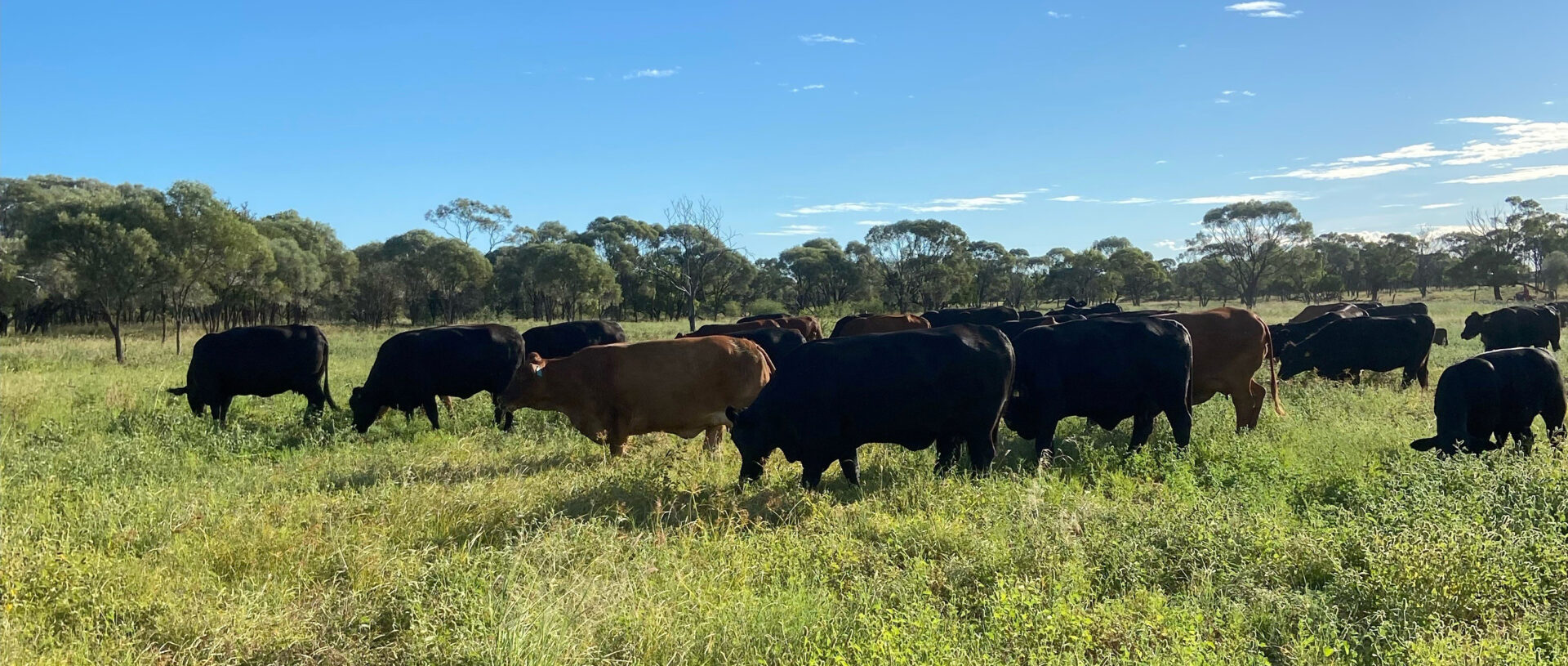
Atherton Pastoral, situated in the Flinders Shire near Hughenden, Queensland, showcases how integrating Angus genetics into a northern crossbred system can improve herd fertility, growth, and meat quality and provide diverse market opportunities during variable Northern seasons.
Atherton Pastoral carries 2,000 joined breeders and progeny through to slaughter on their 150,000 acres (~60,700 hectares) of diverse country ranging from forest country to Mitchell Grass plains with patches of pulled Gidgee. With an average annual rainfall of 460 mm (18 inches) and carrying capacity of around 1 animal equivalent (AE) to 20-40 acres, depending on the land type, the business predominantly supplies grass-finished cattle to processors accredited under Meat Standards Australia (MSA) and the European Union (EU). The current breeder herd is based on a cross between Droughtmasters and Angus, a foundation that has proven well-suited to northern Queensland’s climate and markets.
Evolution of the Business & Adoption of Angus Genetics
Atherton Pastoral has been in operation for over 20 years, adapting its scale to seasonal conditions. The current owner-operator grew up steeped in the Australian beef industry, with a family history that includes establishing a Droughtmaster stud in the 1980s. Since taking control in the mid-2000s, they have actively engaged in university-led cattle trials, which have helped to shape a data-driven approach to herd management and genetics.
According to the Atherton’s, the biggest take-aways from these trials have been the value of networking with industry professionals, gaining exposure to new ideas, and the importance of recording herd data to make informed breeding and management decisions.
“The decision to bring Angus genetics into the mix came from family experience and a focus on producing earlier maturing, heavier calves with better temperament.”
The decision to incorporate Angus bulls began two decades ago, motivated by successful family experience with Angus cattle in NSW and Victoria. This integration aimed to improve fertility, produce earlier maturing heifers, increase weaning weights, and enhance temperament.
Frank Atherton believes these benefits are clearly evident in his herd and remain key reasons why he continues to use Angus genetics. Today, Angus genetics influence approximately 80% of the herd, playing a vital role in achieving Atherton Pastoral’s breeding objectives.
“We’ve been using Angus bulls for about 20 years now, and the benefits to fertility and growth are clear in our herd.”
Breeding & Genetic Strategy
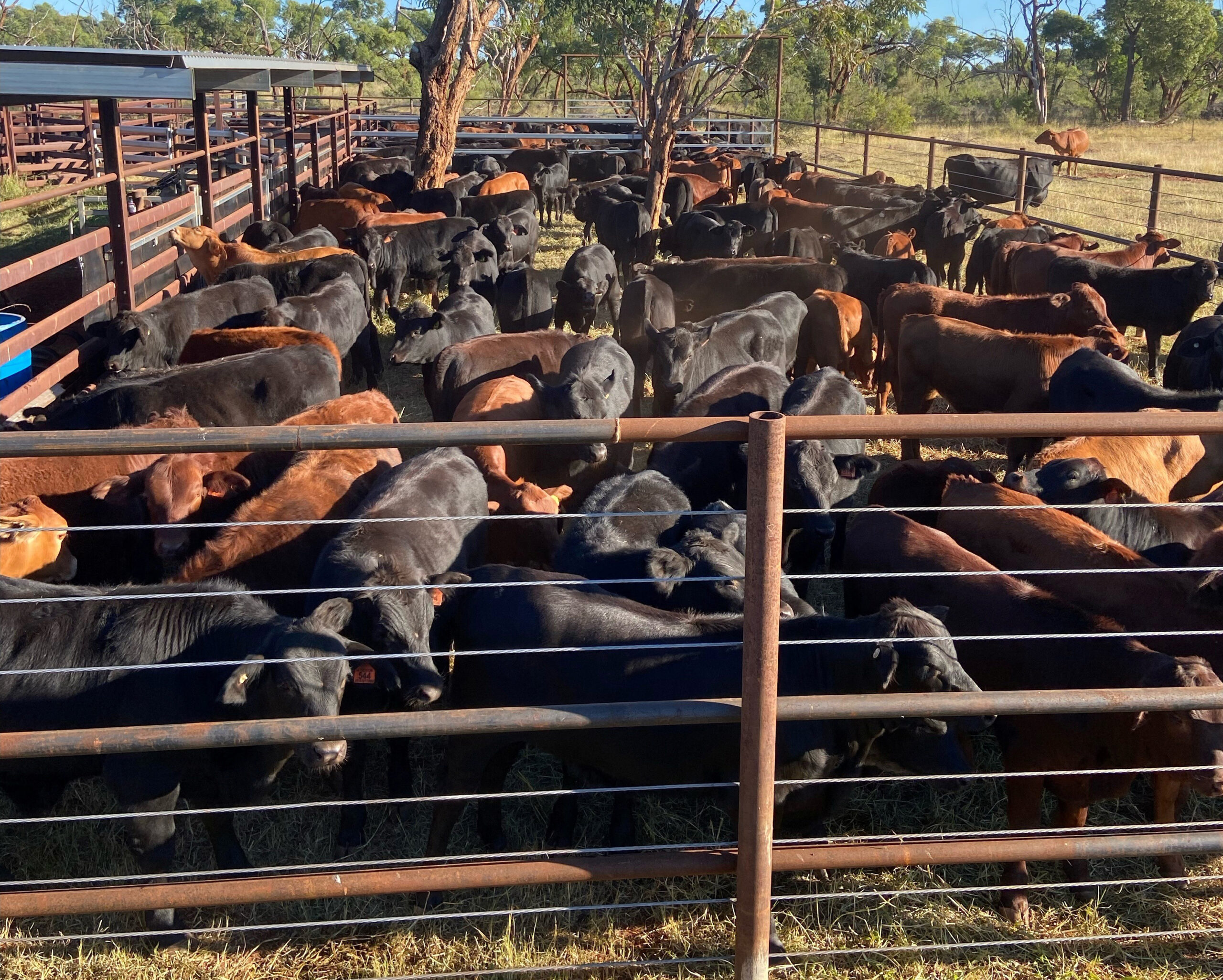
Atherton Pastoral’s breeding objectives centre on producing fertile, productive breeders that deliver healthy calves annually and meet MSA grading by 24 months. In recent years, 75% or more of steers have met these production goals, although results remain seasonal dependent.
Bull selection prioritises objective selection using EBVS, with key traits including structural soundness, low birth weight, milk production, intramuscular fat, days to calving, and growth both 400- and 600-day weight.
Females are joined from January through April over a 12-week period, with a bull-to-heifer ratio of 1:50. Heifers are joined once they reach around 300 kg, typically between 12–16 months of age, although timing may change depending on seasonal conditions to capitalise on different market opportunities.
Bulls — whether pure Droughtmaster, Angus, or Droughtmaster-Angus crosses — are carefully selected and allocated to females based on their coat type and colour. This matching strategy helps maintain an element of Bos indicus content in the animals, supporting herd adaptability and resilience, while also promoting compatibility that benefits fertility, calf vigour, and overall uniformity.
“Matching bulls to females based on coat type helps us keep the right balance of traits, including maintaining some Bos indicus content for resilience.”
Effective bull management is critical in Northern Australia’s environment. At Atherton Pastoral, bulls are managed carefully to maintain condition and minimise injury risks. This includes controlling mating pressure, ensuring bulls have access to shade, and spacing watering points at least 2.5 to 3 kilometres apart. Bulls are evenly distributed among these watering points to reduce competition and prevent pizzle injuries, supporting overall bull health and reproductive performance.
Conception rates average around 80% on forest country and 90% on the downs, reflecting the variation in pasture quality and environmental conditions between these two land types. This performance is supported by targeted supplementation with multiple types of loose lick minerals tailored to the seasonal requirements of each country type, with a particular focus in the forest country to support conception rates.
“Our conception rates vary between country types, averaging around 80% on forest country and 90% on the downs, which reflects the differences in pasture and environment.”
Females that conceive are generally retained, with culling decisions based primarily on age (typically around 10 years), temperament, and reproductive performance (Preg-Test Empty [PTE]). This selective retention supports a productive and fertile cow base, which is essential for achieving long-term genetic progress and maintaining herd performance.
Herd Performance & Market Focus
Atherton Pastoral targets steers finished on grass between 600 and 650 kg, typically reaching 2 to 4 tooth age at sale. Demand for their cattle remains strong among meatworks buyers, feedlots, backgrounders, and breeders due to consistent temperament and fertility.
Within the operation, Angus-influenced progeny are demonstrating measurable advantages compared to cattle with lower Angus content, including:
• Weaners averaging 20 kg heavier at the same age
• Finished cattle weighing 80–100 kg more at comparable ages
• Improved MSA compliance and carcase quality, with 96% of animals being MSA compliant in a recent kill.
• These higher pregnancy-to-first service (PTIC) percentages
Improvements have contributed to stronger performance indicators—pregnancy rates, weaning percentages, and MSA grading—supporting profitability and market access.
“Using Angus genetics has helped us increase the weight of our weaners by about 20 kilograms and finished cattle by up to 100 kilograms.”
The advantages of the crossbred cattle extend beyond grass finishing, providing Atherton Pastoral with the flexibility to supply feedlots when seasonal conditions limit pasture availability. This adaptability helps optimise market opportunities and maintain consistent turnoff despite variable northern seasons.
“The Angus influence improves not only growth but also our ability to meet MSA standards, which is important for our market access.”
Enduring Success
Atherton Pastoral demonstrates how incorporating Angus genetics into a northern crossbred system can improve herd productivity, fertility, and meat quality. The operation combines industry experience with current breeding practices and nutrition management to operate effectively under environmental and market conditions.
Looking forward, Atherton Pastoral plans to continue focusing on innovation and genetic improvement to maintain its position in northern Australian beef production.
Written by Hanlie Jansen Extension Officer Angus Australia, and first published in the 2025 Spring Angus Bulletin.