Announcing the 2026 Angus Foundation Research Grant Recipients
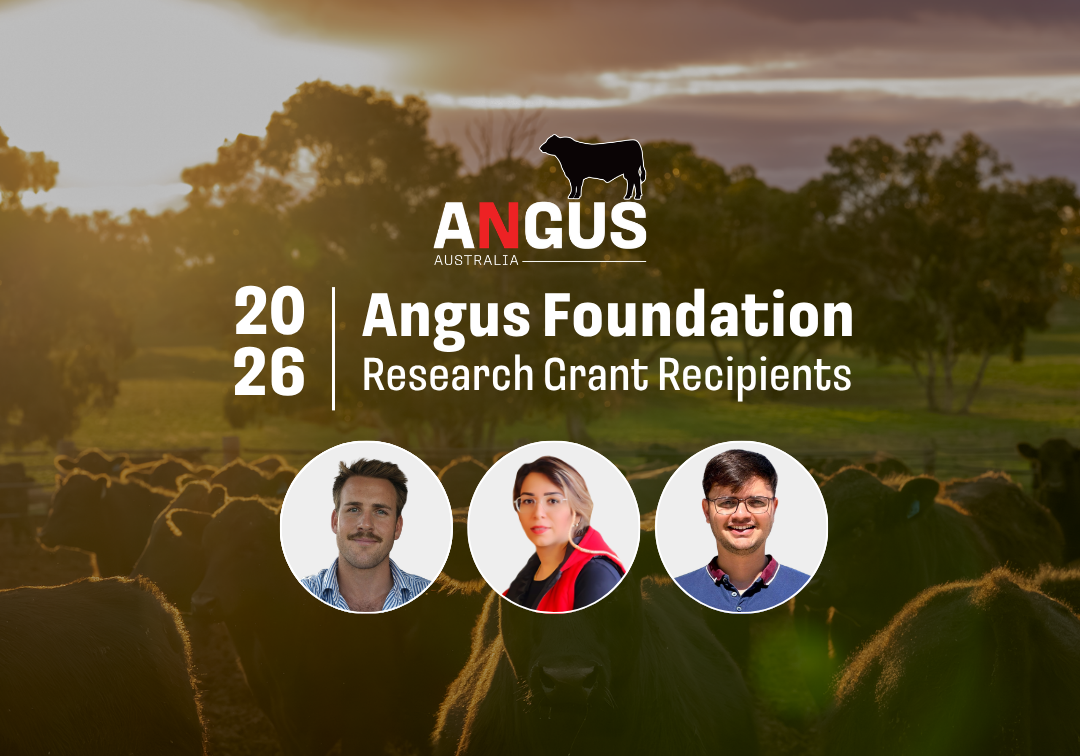










The Angus Foundation is excited to announce the recipients of the 2026 Angus Foundation Research Grant after an extensive selection process.
The Angus Foundation Research Grant supports undergraduate and postgraduate students in conducting research that benefits the Australian beef industry and aligns with Angus Australia’s goal of enhancing the value of Angus cattle and beef. The grant can be utilised for initiating new projects or for deriving additional insights from existing research that the individual or institution has already started.
After a successful shortlisting process and presentations to a selection committee, the Angus Foundation extends its congratulations to the following researchers, Jack Wood (CSU), Mehrnush Forutan (UQ) & Manjul Gautam (ANU) who have been awarded the Research Grant to support their respective projects.
Angus Australia will oversee these projects over the course of the year and provide updates to members as the research findings become available.
JACK WOOD – CHARLES STURT UNIVERSITY (CSU)

Project Title: Investigating the effect of short-course omega-3 (linseed) supplementation around maternal recognition of pregnancy on embryonic survival in Angus embryo-transfer recipients: a preliminary, prospective randomised controlled trial.
Assisted reproductive technologies (ART), led by fixed-time AI and embryo transfer (ET), are the engine of genetic gain in Australian beef herds, especially Angus seedstock, yet a persistent inefficiency remains: a high proportion of transferred embryos fail during pregnancy establishment, spanning uterine entry, hatching/elongation, maternal recognition of pregnancy (MRP), and the onset of attachment. This attrition erodes the realised value of elite embryos, inflates the cost of investment, and slows genetic progress. Because fertilisation is controlled in ET, residual variability largely resides with the recipient uterine–luteal environment: adequate, timely progesterone (P4) from the corpus luteum and a uterine eicosanoid profile that avoids premature luteolysis. Nutritional lipids modulate these pathways. Omega-3 (n-3) polyunsaturated fatty acids, particularly alpha-linolenic acid (ALA), have mechanistic plausibility for shifting endometrial prostaglandin synthesis away from luteolytic PGF₂α and supporting luteal function, thereby improving the biochemical context for conceptus signalling at MRP. While n-3 supplementation of donors has been associated with improved oocyte/embryo quality, recipient-side fertility effects remain unchartered.
To isolate recipient effects, the present study transfers high-quality, confirmed-fertilised, stage-matched embryos from registered Angus donors, ensuring that any response is attributable to the recipient milieu rather than embryo heterogeneity. In parallel, we pilot a low-disturbance monitoring framework, pairing simple blood-based indicators with structured oestrus observation, to time-stamp loss before and after MRP in a manner that is cost-efficient for producers alongside ART.
Research objective. To determine whether short-course n-3 supplementation of Angus recipients improves pregnancy establishment after ET, and, if so, to elucidate the recipient-side pathways involved, specifically, (i) enhanced luteal P4 support across the peri-MRP window and (ii) reduced peri-MRP loss consistent with moderated luteolytic tone. The anticipated outcome is breed-relevant evidence and a practical, scalable protocol (amenable to feed or water delivery) that can be adopted by Angus studs and Angus-influenced herds to not only protect embryo investments but to lift fertility and better understand the mechanism of n-3 supplementation.
MEHRNUSH FORUTAN – UNIVERSITY OF QUEENSLAND (UQ)

Project Title: Advancing Angus Cattle Genetics for Improved Heat Tolerance
Angus and Angus-derived females account for almost half of Australia’s national breeding herd and play an increasingly important role in northern beef production systems. Producers across commercial and seedstock operations consistently report strong advantages when incorporating Angus genetics into northern herds. These benefits include improved fertility with higher calving rates, enhanced hybrid vigour that drives stronger maternal performance and earlier turn-off, increased polledness reducing handling stress, and better market access supported by Meat Standards Australia (MSA) grading and Angus-branded premium beef programs. Incorporating Angus genetics into northern herds reliably enhances meat quality, tenderness, and market suitability, demonstrating the strong contribution Angus makes to northern production systems.
A remaining challenge, however, is that Angus cattle—like many temperate breeds—show reduced adaptation to high heat loads. With heat stress events becoming more frequent and intense, improving heat tolerance within Angus genetics represents a proactive opportunity to strengthen the breed’s suitability and performance in northern Australia. Genetic selection provides a permanent and cumulative avenue for change, particularly valuable in extensive grazing systems where environmental modification is limited. While major progress has been achieved in dairy cattle, including Australia’s release of the first genomic breeding values (GEBVs) for heat tolerance in 2017, equivalent tools for beef cattle are still emerging despite clear evidence of heritable variation. Feed intake is one of the traits most sensitive to heat stress, typically declining once temperature-humidity index (THI) exceeds 68.
This project aims to position Angus cattle for future climatic conditions by identifying the genetic drivers of heat tolerance. By integrating individual feed intake records with local weather data, we will quantify the reduction in intake per unit increase in THI and estimate GEBVs for heat tolerance. Validated mutations will be incorporated into commercial SNP panels, enabling early-life genomic selection of Angus animals with superior resilience. The outcomes will support continued productivity, welfare, and market leadership of Angus cattle within northern Australia’s beef industry.
MANJUL GAUTAM – AUSTRALIAN NATIONAL UNIVERSITY
 Project Title: Innate Immunity and Moraxella in Infectious Bovine Keratoconjunctivitis (IBK)
Infectious Bovine Keratoconjunctivitis (IBK, or pinkeye) is the most common and highly contagious eye disease primarily caused by bacteria from the gram-negative Moraxella species, including M. bovis, M. ovis, and M. bovoculi (hereafter, referred to as M. obb.). IBK is characterised by scarring, blindness, and a substantial reduction in body weight, ultimately affecting beef production and animal welfare. Current interventions, including antibiotics and vaccines, are not effective and have been rendered unsustainable due to frequent annual outbreaks and increasing antibiotic resistance. We have recently discovered a novel host sensing mechanism wherein M. obb. activates the innate immune sensor called NLRP3 and induces inflammation and cell death in primary immune cells such as macrophages. We hypothesise that M. obb.-mediated activation of NLRP3 drives IBK pathogenesis and induces corneal inflammation. This project aims to identify host factors involved in the pathogenicity of IBK and establish an in vivo disease model to test whether targeting the NLRP3 pathway reduces disease burden. This research will lay the foundation for antibiotic free host-inspired immune therapies and to enhance Angus beef production and Angus welfare.